




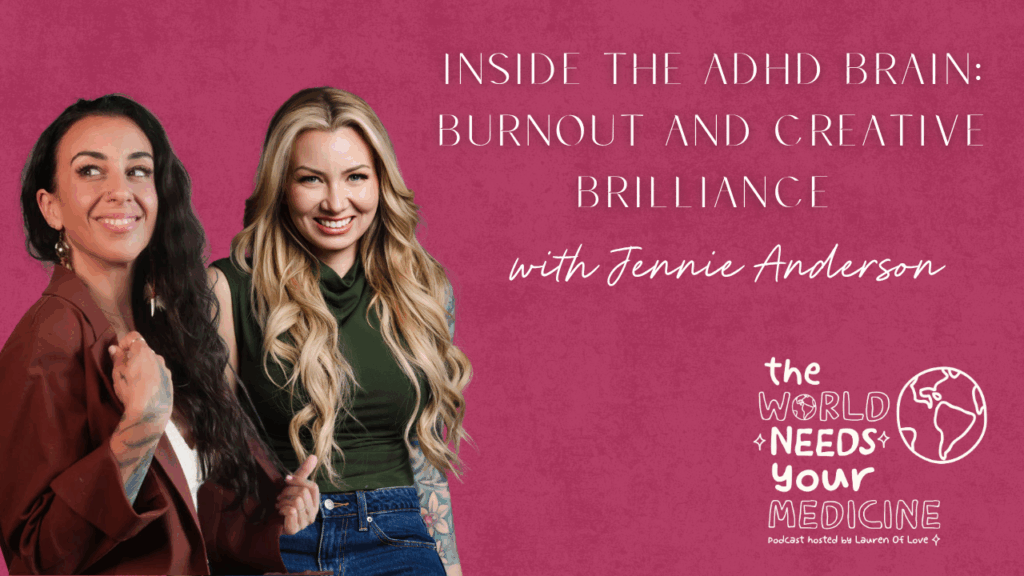
ADHD is one of the most studied and most misunderstood diagnoses out there – and for millennial women especially, it’s showing up later in life in ways nobody prepared us for.
This week on The World Needs Your Medicine, I sat down with Jennie Anderson – a registered nurse turned entrepreneur and coach who works with brilliant women with ADHD-style brains to stop treating themselves like the problem. She helps women rebuild self-trust beneath the layers of procrastination, masking, inconsistency, and shutdown.
I told Jennie from the jump that this conversation was going to be 95% me picking her brain in public, and I meant it. There’s so much about ADHD that I’ve been curious about but hadn’t fully explored, and she brought such clarity to all of it.
She walked us through what ADHD actually is – not the childhood version most of us were taught, but what it looks like in adult women. The three types of ADHD-style brains. How the diagnostic criteria in the DSM is still largely built around kids, which means so many women are falling through the cracks. And how there’s a clinician named Russell Barkley who’s actually pushing for a new adult-specific category that includes emotional regulation, which the current system completely ignores.
As someone who has her own feelings about the DSM… I felt very seen in that moment.
The hormonal piece no one talks about
One of the things Jennie shared that really landed for me was the connection between estrogen and dopamine. As estrogen levels drop – which starts happening in our 30s with perimenopause – dopamine levels drop too. And a neurodivergent brain already doesn’t have enough receptors to take in dopamine the way a neurotypical brain does.
So that season so many of us hit in our early 30s where everything feels harder and we can’t figure out why? There’s actually a biological explanation for it.
For Jennie, that’s when she got re-diagnosed. She’d first been told she had ADHD at 15, but nobody did anything about it. It wasn’t until she was 30, working in emergency medicine, that a moment at work made her realize something deeper was going on with her brain. She went back, got tested, and really dove into understanding what it means to live with a neurodivergent mind.
For me, looking back, my own heightened awareness of my neurodivergence was birthed in that same season – the 30s, the hormonal shifts, the feeling of coming full circle to something that had always been there.
Hyper focus, burnout, and the cycle in between
One of my favorite parts of the conversation was when Jennie broke down hyper focus – what it actually is and how it’s different from hyper fixation.
She described it as this state where you get so much dopamine flowing that you go all in, tunnel vision kicks on, time melts away… and then suddenly the sun went down 17 hours ago and you haven’t eaten, had water, or noticed anything outside the thing you were creating.
And then what follows is the crash. The burnout. The “what is wrong with me” moment. And because ADHD brains live in a now-or-right-now state, when you’re in that low, it feels like it’s always been that way and always will be. Until the next wave of creative brilliance comes through and the whole cycle starts again.
I felt that in my body as she was speaking. That pattern of magic followed by collapse… I’ve watched so many women I love move through it without understanding what’s actually happening in their brain.
Rest, shame, and the story underneath
Something Jennie said that I think everyone needs to hear – whether you identify with ADHD or not – is how deeply productivity is tied to self worth for so many of us.
She named the pattern so clearly… when we’re doing nothing, there’s shame. When we rest, we feel guilty. When we take 20 minutes to just let our brain wander, we reach for our phone instead because at least scrolling gives us a little hit of dopamine without the discomfort of actually being still.
And I know that one personally. I grew up in an environment where rest was basically the worst thing you could do. My mom, when I really trace it, had a trauma response that showed up as hyper-vigilant over-functioning. She was uncomfortable with the mirror of anyone around her not matching that energy. So she’d unconsciously rally the kids into that same frequency. And I carried that pattern into years of my entrepreneurial path – always feeling like I had to be productive, never knowing how to stop.
What that ended up creating was this deep resistance to the actual money-making things I can so beautifully offer the world today. I had so much healing to do around it.
Jennie’s reframe was so simple and so needed… rest is fuel. Not a reward. Not something to earn. Fuel.
Rejection sensitivity and the fear of being seen
We also talked about something called rejection sensitivity dysphoria – or RSD – which Jennie described as not just rejection but perceived rejection, felt on such a deep level that it’s physically painful.
She connected it back to childhood, and the research that shows neurodivergent kids are corrected more often, told they’re doing something wrong more frequently, and met with more negativity than neurotypical kids. So by the time you’re an adult, there’s this deeply wired belief that if you put yourself out there and it’s perceived as wrong, the pain will be unbearable.
And then she said something that cracked me open a little…
She talked about growing up without parents, being told she was never wanted, being bullied anytime she tried to be seen. And then she chose social media marketing as her career path. She laughed about it, but the courage underneath that choice is staggering.
And what she said next is something I keep coming back to… will she be rejected? 100%. But she’ll also find the people she’s meant to help by being her truest self. And that’s why she’s here.
The grief of waking up to it
I shared with Jennie that when I woke up to my own diagnosis, there was a lot of grief. And she nodded before I even finished the sentence.
She described this cycle that so many women go through after a later-in-life diagnosis… first the relief of finally feeling seen. Then the weight of realizing it’s actually a disability. Then the anger – if I had known this sooner, I’d have a completely different life. Then the mourning of the life you thought you were supposed to have.
And then, eventually… the light. The recognition that you’ve actually done incredible things with a brain that works completely differently from the world around you. That you’re resilient. That you can create anything.
I think the world needs more women in their millennial era being neurodivergent and actually speaking to it and opening up about it. Because the first part of claiming your magic is self acceptance. And when we see women in this umbrella who start elevating their experience instead of hiding it, it’s truly inspiring for everyone.
Self-trust as the foundation
If there was one thread that wove through the entire conversation, it was self-trust.
Jennie said it’s the biggest takeaway she could offer anyone – and also the hardest lesson she had to learn herself. She talked about how so many of her clients come to her saying they don’t even know what their intuition sounds like anymore because they’ve silenced it for so long.
Her advice? Start with play. Think back to when you were a little kid. Give yourself time to just be a human. Let yourself try things without the emotional tie – no shame, no guilt, everything is a science experiment.
And I loved that so much, because regardless of anything we do in this life, we have to build a really good sense of intuitive knowing. We have thoughts, we have feelings, and then we have intuition – this really deep, calm, clear, certain channel within us that our childhood and conditioning taught us to ignore.
The reclamation of that is everything.
Honoring your energy instead of overriding it
Near the end, Jennie shared a tool she uses with her clients that I think is brilliant in its simplicity. She calls it the green, yellow, red energy system.
Green is that day where you feel unstoppable – your best self, fully alive, ready to conquer. Yellow is where she says we actually want to live most of the time – still good, still productive, but more balanced. And red is the day where you’re tired, depleted, or doing heavy emotional work.
Her approach on red light days is to strip everything off your to-do list that doesn’t absolutely have to happen and let yourself sit in that energy. Because when you give yourself permission to be in the red instead of fighting it, you move through it so much faster.
That alone felt like a gift for every woman who has ever pushed through exhaustion and called it strength.
What this conversation left me with
I walked away from this episode feeling something I don’t always feel after a conversation about mental health… I felt lighter. Jennie brings this energy that’s both deeply informed and genuinely joyful. She loves the people she works with, she loves the brain she was given, and she’s committed to helping other women get there too.
I feel like we’re here as neurodivergents leading. Showing a different way. Being the ones who say – yes, let’s do it this way. Let’s honor our brains. Let’s meet our needs. Let’s stop treating ourselves like the problem and start recognizing the magic we’ve been carrying all along.
This episode is now live and you wont want to miss it. Tune in below!
Xoxo, Lauren
LISTEN ON APPLE PODCASTS

get my free SIX LAWS OF
WEALTH AUDIO TRAINING


Hello Beautiful!
I'M LAUREN!
I transformed my life through healing, inner work and money magnetism. I've dedicated my work to helping the old version of me find her alignment to manifest a dream life and relationship with herself. And if you're here, I'm so happy!


